Building a barndominium in the Texas Hill Country
The full sequence, from evaluating land to move-in, with the costs and rules that are specific to Hill Country acreage.
Updated , about 6 minutes to read
A barndominium is a home built with a steel frame and metal shell, usually with shop, garage, or storage space under the same roof as the living quarters. In the Texas Hill Country, most of them go up on acreage outside town, where the building is only half the project. The other half is water, septic, power, and access, and those items decide whether a budget holds.
This guide walks through the project in the order you will face it.
Step 1: Evaluate the land before you buy
The cheapest time to find a problem is before closing. Work through this list on any tract you are serious about.
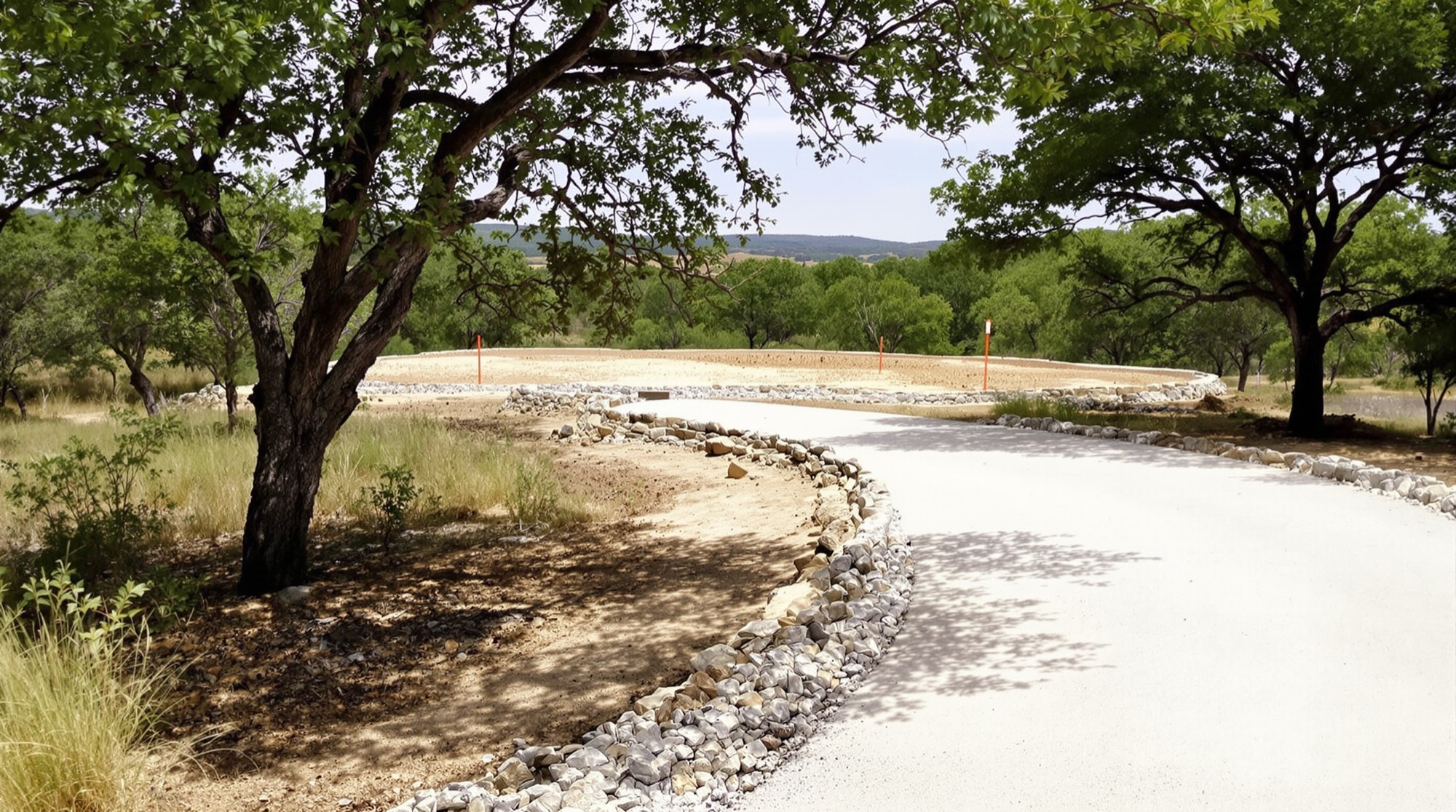
Water
- Ask neighbors how deep their wells are and how much they produce.
- Check the local groundwater conservation district's rules. In Gillespie County that is the Hill Country Underground Water Conservation District.
- Budget $15,000 to $35,000 for a drilled and equipped well. Deep wells cost more.
Septic
- Shallow limestone and caliche often rule out a conventional drain field.
- Aerobic systems are common across the region and typically run $12,000 to $22,000.
- A site evaluation by a licensed septic designer tells you which system the county will approve.
Floodplain and drainage
- Check FEMA flood maps for the building site and the driveway route.
- In Gillespie County, the County Engineer must sign a floodplain determination before the county will complete a septic application.
- Low-water crossings can cut off access after heavy rain.
Power
- Find the nearest electric line. Central Texas Electric Cooperative serves most of rural Gillespie County, and Pedernales Electric Cooperative serves parts of the region.
- A long line extension can cost $5,000 to $30,000 or more. Get the co-op's estimate in writing.
Access and restrictions
- Confirm legal, recorded access to the property.
- Read the deed restrictions. Some rural subdivisions limit metal exteriors, set a minimum home size, or ban short-term rentals.
- If the land has ag valuation, learn what it takes to keep it. See our guide to ag valuation and barndominiums.
Step 2: Set a realistic budget
Hill Country barndominium budgets have three parts: the building, the site work, and a contingency.
The building. For finished living area, current Hill Country figures run roughly:
| Finish Level | Living Area, per sq ft |
|---|---|
| Practical | $165 to $200 |
| Custom mid-range | $200 to $275 |
| Premium | $275 to $400+ |
Shop, garage, and RV bay space under the same roof costs less, often $60 to $110 per square foot.
The site work. On raw acreage, expect:
| Item | Typical Range |
|---|---|
| Water well | $15,000 to $35,000 |
| Septic system | $12,000 to $22,000 |
| Electric line extension | $5,000 to $30,000+ |
| Driveway or access road | $5,000 to $20,000+ |
| Pad cut, rock removal, grading | $10,000 to $40,000+ |
| Drainage and erosion control | $8,000 to $25,000 |
Most tracts land between $60,000 and $120,000 for site work.
The contingency. Carry 10 to 15 percent of the total. Rock, weather, and design changes use it up faster than most owners expect.
A worked example: 2,500 square feet of living space at a custom mid-range finish costs $500,000 to $690,000. Add $60,000 to $120,000 of site work, and the project comes to roughly $560,000 to $810,000 before land and contingency.
Step 3: Design around how you use the land
The steel frame spans the full width of the building, so interior walls carry no roof load. That freedom is the main reason people choose a barndominium. Spend it on the things that matter on acreage:
- Shop and RV space. A Class A motorhome needs a 14-foot-tall door and 16 feet or more of clear height. A workshop needs 240-volt circuits and, in a Texas summer, insulation and cooling.
- Porches. Deep overhangs on the south and west walls cut cooling loads and give you outdoor living space most of the year.
- Orientation. Face the main windows toward the view and away from the afternoon sun where you can.
- Insulation. Closed-cell spray foam stops condensation on steel and keeps summer heat out.
- Exterior. Limestone wainscot, wood accents, or board-and-batten siding help a barndominium fit the region and satisfy deed restrictions that limit all-metal exteriors.
See barndominium types and layouts for typical sizes and specs.
Step 4: Get the right approvals
The rules depend on whether the property sits inside a city.
Inside Fredericksburg city limits, the City issues building permits and inspects construction. Kerrville, Boerne, Marble Falls, and other incorporated towns run their own permit programs too.
In unincorporated Gillespie County, the county does not issue residential building permits or send building inspectors. State law requires new homes in some unincorporated areas to follow the International Residential Code, but it does not require the county to approve plans first. You will still need:
- A floodplain determination from the County Engineer
- An on-site sewage facility (OSSF) permit from the county
- Compliance with the groundwater district's well rules
- Electric service approval from the co-op
With no county inspector involved, hire an independent inspector to check the foundation, framing, and work before drywall goes up. Write those inspections into your construction contract.
Step 5: Line up financing early
Barndominium financing takes more legwork than a standard mortgage.
- Construction loans. Most owners use a construction loan or a construction-to-permanent loan. The lender releases money in draws as work is completed.
- Appraisals. Appraisers need comparable sales. In areas with few recent barndominium sales, the appraisal can come in below cost, which affects how much you can borrow.
- Lenders. Local banks and Farm Credit lenders tend to have more experience with rural homes on acreage than national mortgage companies do.
- Land. If you finance the land separately, ask early whether the lender can roll the land loan into the construction loan.
Ask lenders how many barndominium loans they closed in the past year, and get their draw schedule before you sign with a builder.
Step 6: Choose a builder carefully
Texas has no state license for general contractors or home builders, so a license number cannot help you here. Electricians, plumbers, and HVAC contractors do need licenses from the Texas Department of Licensing and Regulation. Ask every builder you interview for:
- Proof of general liability and workers' compensation coverage
- References from rural builds completed in the last two years, with permission to visit
- A written warranty, with what it covers and for how long
- A line-item estimate that separates site work from the building
- The names and license numbers of the electrical, plumbing, and HVAC trades
- A draw schedule tied to completed work, not dates
Compare bids line by line. A low number that leaves out the well, septic, or driveway will not stay low.
Step 7: Know the timeline
| Phase | Typical Duration |
|---|---|
| Land due diligence and purchase | 1 to 3 months |
| Design and engineering | 2 to 4 months |
| Floodplain, septic, or city permits | Several weeks |
| Site work and foundation | 1 to 3 months |
| Steel frame and exterior | 1 to 2 months |
| Interior and finish | 4 to 6 months |
From first meeting to move-in, a custom Hill Country barndominium usually takes about a year once you own the land.
If you plan to rent it out
Guest houses near Fredericksburg attract wine country visitors, but the rules vary by location. Inside city limits, stays under 30 days require a City short-term rental permit, an inspection before the permit is issued and at each annual renewal, and the City caps permits by zone. In unincorporated Gillespie County, you must collect the 6% state and 7% county hotel occupancy tax. Deed restrictions can ban short-term rentals anywhere, so check them before you buy.
Next steps
If you own land or have a tract under contract, request a consultation. We'll go through the property, the budget, and the layout you have in mind.
Sources
- Gillespie Central Appraisal District: Ag Use Standards and Guidelines
- Gillespie County Sanitation Office (OSSF permits)
- City of Fredericksburg: Short-Term Rental Permit FAQs
- Gillespie County: County Hotel Occupancy Tax
- Texas Local Government Code §233.153
- CMW General Contractors: Hill Country barndominium costs in 2026
Rules, rates, and costs change. Confirm details with the agency or a qualified professional before you act on them.
Start with your land
Tell us about your property. We'll talk through well, septic, access, and layout, then map out what your build will take.
Building across Fredericksburg, Kerrville, Johnson City, Marble Falls, Llano, Boerne, Comfort, Stonewall, Doss, Harper.