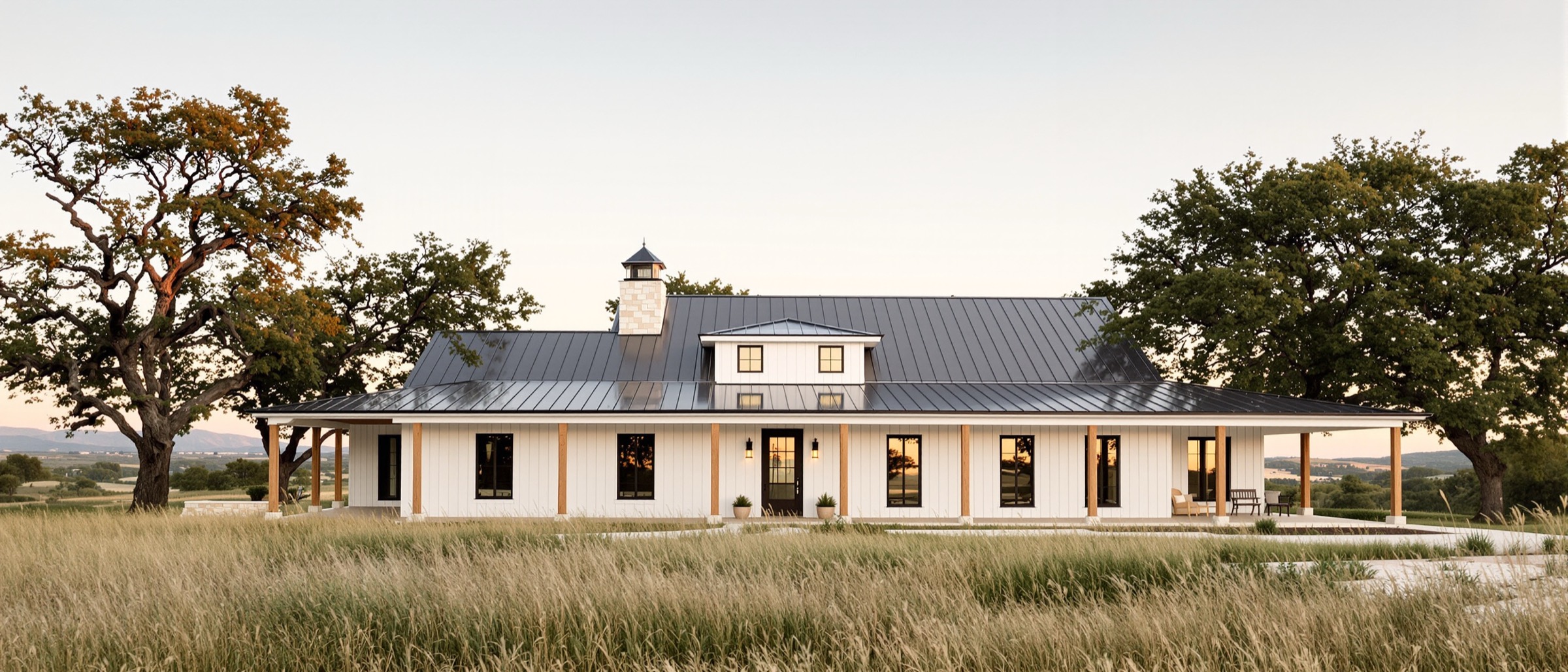
Barndominiums for Texas Hill Country land
Custom barndominiums on acreage around Fredericksburg, planned from the ground up: the well, the septic, the building site, and then the house.
The land comes first
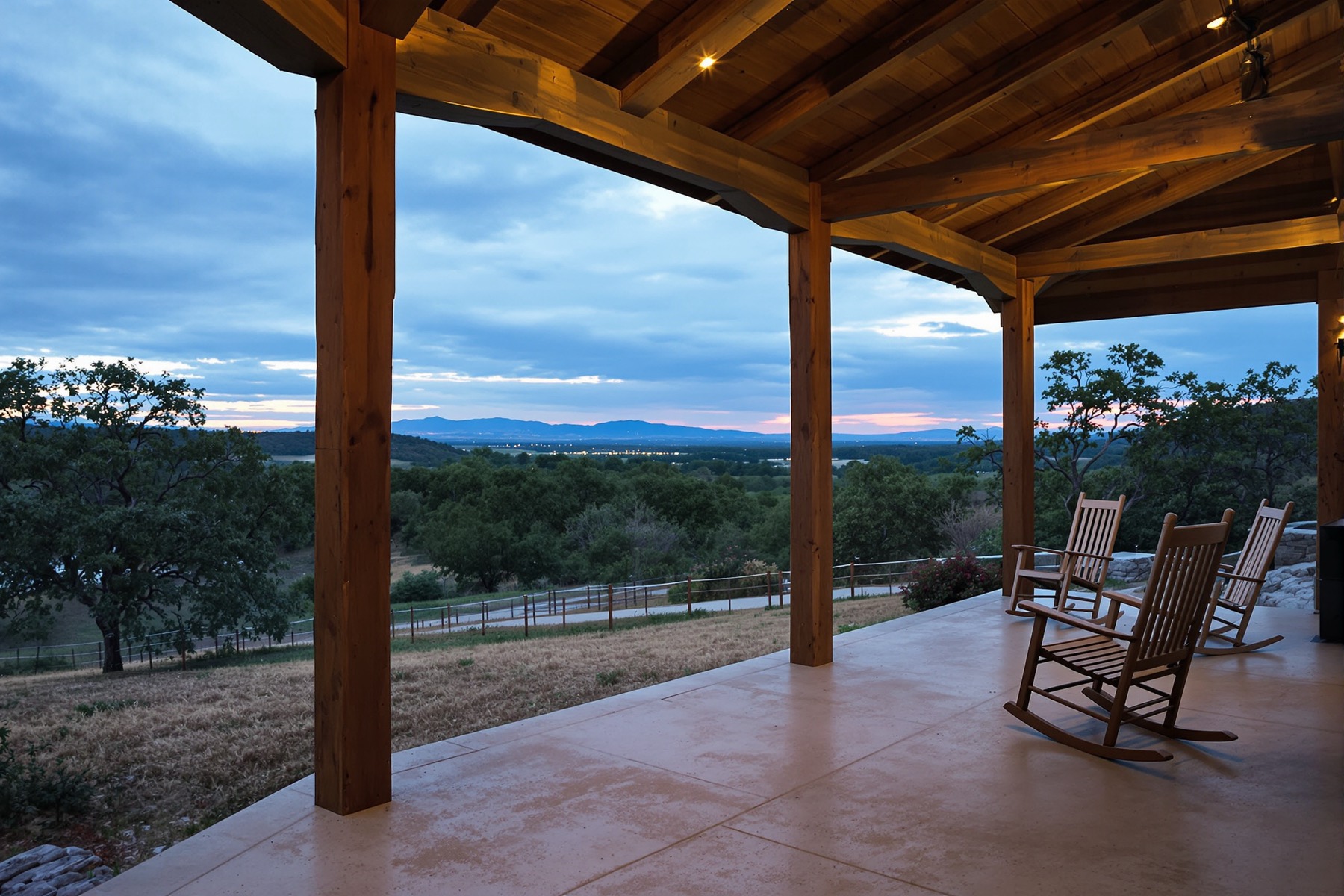
A barndominium puts your home and your working space under one steel roof. On Hill Country acreage that usually means living quarters beside a shop, an RV bay, or equipment storage, with a long porch facing the view.
The building is the easy part. The land decides most of your budget. Before anyone draws a floor plan, you need answers to a handful of questions about the property itself:
- How deep is the water, and what will the well cost?
- Will the soil support a conventional septic field, or does shallow rock call for an aerobic system?
- How far is the nearest power line?
- Does part of the tract sit in a floodplain?
- How much rock and caliche sit under the building pad?
Those answers can swing a project by $60,000 to $120,000 before the slab is poured. We work through them first, so the estimate you see reflects your land and not an average.
What we build
| Structure Type | Typical Size | Best For |
|---|---|---|
| Workshop homes | 2,000 to 3,500 sq ft | Living space plus shop, RV, or equipment bays |
| Guest houses | 1,000 to 2,000 sq ft | Family visits, caretakers, or rental income |
| Multi-generational homes | 3,500 to 5,000+ sq ft | Two households sharing one property |
| Barns and shop buildings | Sized to the use | Equipment, hay, and workshops with or without living quarters |
See barndominium types and layouts for the specs behind each one, or barns and shop buildings if you are starting with the barn.
What a Hill Country barndominium costs
For the finished living area, plan on roughly:
| Finish Level | Living Area, per sq ft |
|---|---|
| Practical | $165 to $200 |
| Custom mid-range | $200 to $275 |
| Premium | $275 to $400+ |
Shop and RV bay space under the same roof costs less, often $60 to $110 per square foot. None of these figures include land or site work. Well, septic, power, driveway, and pad preparation on raw acreage commonly add $60,000 to $120,000. A 2,500 sq ft custom home with site work usually lands between about $560,000 and $810,000 before land.
The services and costs page breaks the site work down line by line.
City or county: know which rules apply
Inside Fredericksburg city limits, the City of Fredericksburg issues building permits and inspects construction.
Outside the city, Gillespie County does not issue residential building permits or send building inspectors. The county does permit your septic system, and the County Engineer must sign a floodplain determination before the septic application counts as complete. With no county inspector on the job, independent third-party inspections at the foundation, framing, and pre-drywall stages protect you. Write them into your contract.
Ag valuation: what it covers
Many buyers hear that a barndominium "qualifies for an ag exemption." The building does not. Texas ag valuation lowers taxes on land in qualifying agricultural use. Gillespie Central Appraisal District appraises homes and barns at market value, and the homesite land is taxed at market value as well.
The rest of your acreage can still qualify. Grazing, hay, orchards, vineyards, and wildlife management can all count if you meet the district's standards. Plan the homesite and the working land together, and the tax savings on the acreage hold up. Our guide to ag valuation and barndominiums covers the details.
Planning from scratch?
Start with our Texas Hill Country barndominium planning guide. It walks through land, water, septic, budget, permits, financing, and choosing a builder, in the order you will face them.
Start with your land. Request a consultation and tell us where your property is and what you want to build.
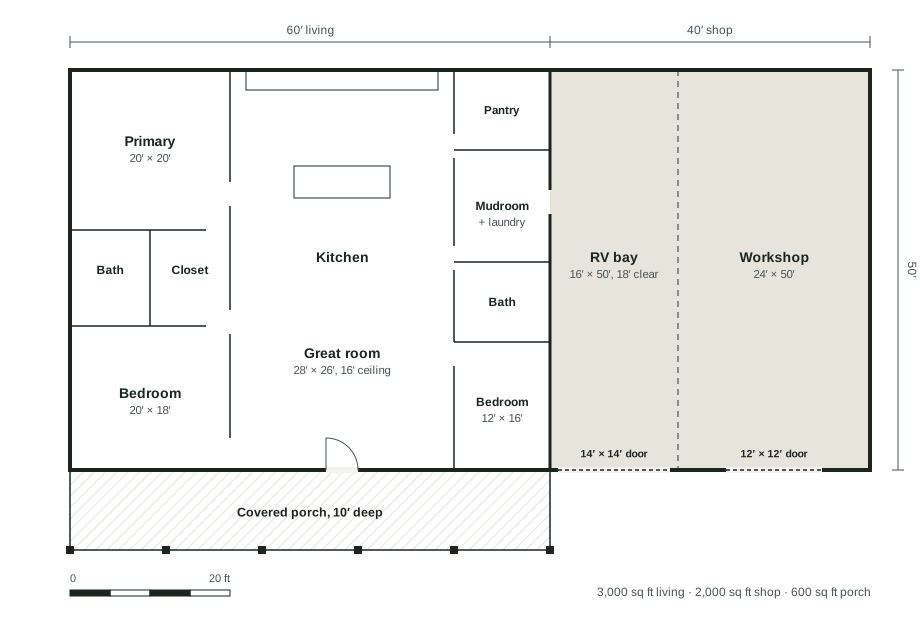
A workshop home, drawn to scale
Three bedrooms and an open great room on one side. A 16-foot RV bay and a workshop on the other. A 10-foot porch across the front. Owners who want shop space under the same roof often start from a layout like this one, then shape it to the land.
How we approach a build
Planning starts with the land
Well depth, septic type, rock, slope, and distance to power can move a Hill Country budget by six figures. We price those items before we talk about finishes.
Straight answers on ag valuation
Texas ag valuation lowers taxes on qualifying land, not on the house. We help you lay out the homesite and the working acreage so you know what the appraisal district will recognize.
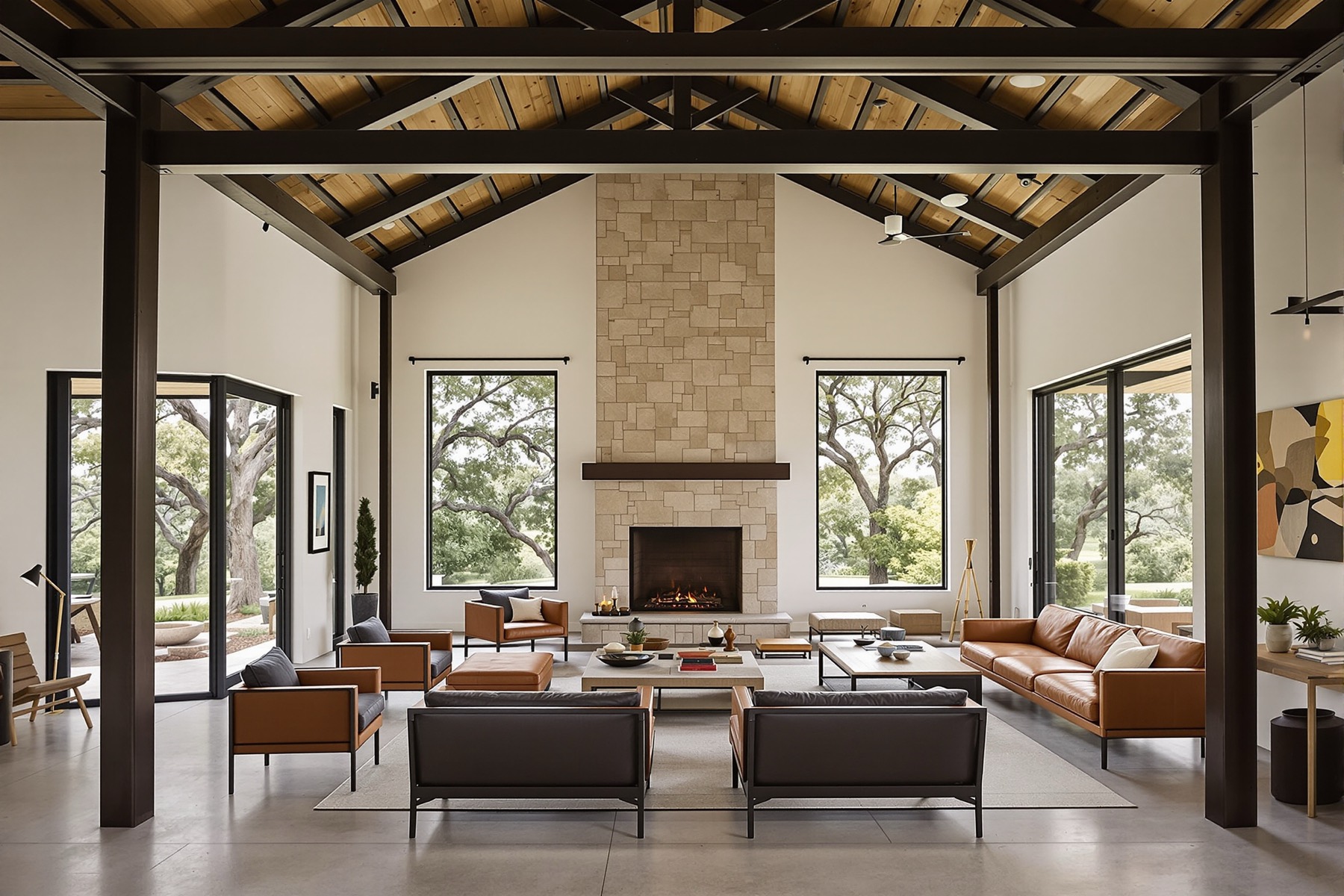
Living space and shop under one roof
Clear-span steel lets you put an RV bay, a workshop, or equipment storage beside the living quarters without interior columns in the way.
From first call to move-in
-
Land and goals consultation
We review your property's location, access, slope, floodplain status, and utility options, then talk through how you plan to use the building.
-
Design and engineering
You get a floor plan that balances living space with shop, storage, or RV needs, plus engineered drawings for the steel frame and foundation.
-
Permits, septic, and floodplain
Inside Fredericksburg city limits, the City reviews plans and inspects the work. Outside the city, Gillespie County permits your septic system and reviews floodplain status first.
-
Site work and foundation
Crews cut the building pad, run the driveway, and pour an engineered slab. Shallow rock and caliche often call for heavier equipment than a flat lot would.
-
Steel frame and exterior
The steel frame and metal shell go up, sized for the site's wind exposure. Overhead doors, windows, and porches get framed in at this stage.
-
Interior finish and move-in
Insulation, mechanical systems, drywall, cabinetry, and finishes. Construction on a custom build usually runs 7 to 12 months, depending on size, finish level, and site work.
Planning guides
These guides cover the questions that come up most when you plan a barndominium on Hill Country acreage. Each one cites the agency or source behind its numbers, and we update them when rules or costs change.
-
Ag exemption and your barndominium in Gillespie County
Ag valuation can cut taxes on Hill Country acreage, but it never applies to the house. Here is what qualifies, what triggers a rollback, and how to plan around it.
-
Building a barndominium in the Texas Hill Country
The full sequence, from evaluating land to move-in, with the costs and rules that are specific to Hill Country acreage.
Common questions
Do I need a building permit for a barndominium in Gillespie County?
It depends on where the property sits. Inside Fredericksburg city limits, the City of Fredericksburg requires a building permit and inspects the work. In unincorporated Gillespie County, the county does not issue residential building permits or run building inspections. You will still need a county septic (OSSF) permit, and since August 2025 the County Engineer's floodplain determination has to be signed before the septic application is considered complete. Because no county inspector visits the job, we recommend independent third-party inspections at the foundation, framing, and pre-drywall stages.
Does a barndominium qualify for an agricultural exemption in Gillespie County?
The house does not. Texas ag valuation (known as 1-d-1 open-space appraisal) lowers taxes on land that is in qualifying agricultural use. Gillespie Central Appraisal District appraises buildings, including homes and barns, at market value, and the homesite land is taxed at market value too. The surrounding acreage can qualify if it has been in agricultural use for at least five of the last seven years and meets the district's intensity standards, such as livestock stocked at about one animal unit per 20 to 25 acres, or orchards and vineyards of at least three acres. Confirm current guidelines with Gillespie CAD before you buy or build.
How much does a barndominium cost in the Fredericksburg area?
For the finished living area, expect roughly $165 to $200 per square foot for a practical build, $200 to $275 for a custom mid-range build, and $275 to $400 or more for premium finishes. Attached shop or RV bay space costs less, often $60 to $110 per square foot. Those figures exclude land and site work. Well, septic, power, driveway, and pad preparation on raw Hill Country acreage commonly add $60,000 to $120,000. A 2,500 sq ft custom home with site work usually lands between about $560,000 and $810,000 before land.
How long does it take to build a barndominium in the Hill Country?
Plan on about a year from first meeting to move-in. Design and engineering take 2 to 4 months. Septic and floodplain approvals in the county, or city permits inside Fredericksburg, add several weeks. Construction on a custom build usually runs 7 to 12 months, and site work on rocky or sloped land can stretch the early phases.
Can a barndominium include an RV bay, a workshop, or equipment storage?
Yes. That is the main reason many owners choose one. A typical RV bay uses a 14-foot-tall overhead door, 16 feet or more of clear height, and a 50-amp RV outlet. Workshops usually get 240-volt circuits for welders and compressors. A clear-span steel frame leaves those spaces open with no interior columns.
Can you build on raw land without utilities?
Yes, and most Hill Country acreage starts that way. Budget for a water well ($15,000 to $35,000 depending on depth), a septic system (aerobic systems, common on shallow rocky soils, often run $12,000 to $22,000), and electric service. Rural Gillespie County is served mostly by Central Texas Electric Cooperative, with Pedernales Electric Cooperative in parts of the region, and a long line extension can cost $5,000 to $30,000 or more. Check the Hill Country Underground Water Conservation District's rules before you drill.
Can I rent out a barndominium or guest house as a short-term rental?
Inside Fredericksburg city limits, any stay under 30 days requires a City short-term rental permit, an inspection before the permit is issued and at each annual renewal, and the City caps the number of permits by zone. In unincorporated Gillespie County there is no City permit, but you must collect the 6% state and 7% county hotel occupancy tax. Deed restrictions and HOA rules can prohibit short-term rentals anywhere, so read them before you buy.
Do Texas barndominium builders need a license?
Texas has no state license for general contractors or home builders. Electricians, plumbers, and HVAC contractors do need licenses from the Texas Department of Licensing and Regulation. When you compare builders, ask for proof of general liability insurance, a written warranty, references from recent rural builds, and the licenses of the trades doing your electrical, plumbing, and HVAC work.
Start with your land
Tell us about your property. We'll talk through well, septic, access, and layout, then map out what your build will take.
Building across Fredericksburg, Kerrville, Johnson City, Marble Falls, Llano, Boerne, Comfort, Stonewall, Doss, Harper.